

Most CS orgs treat onboarding as education: Let us show you how to use the product. For technical buyers, this approach is backwards and borderline insulting.
Engineers would rather not be trained. They want to solve their problem. They’ve already read your docs. They Googled your API. They probably found a GitHub thread where someone had the same edge case they’re worried about. What’s standing between them and production isn’t knowledge. It’s friction.
The fastest path to value isn’t a webinar series. It’s removing every obstacle between the customer’s intent and their first meaningful outcome.
The best onboarding for technical products doesn’t look like customer success. It looks like developer experience design.
The Framework: Time-to-Architecture (TTA)
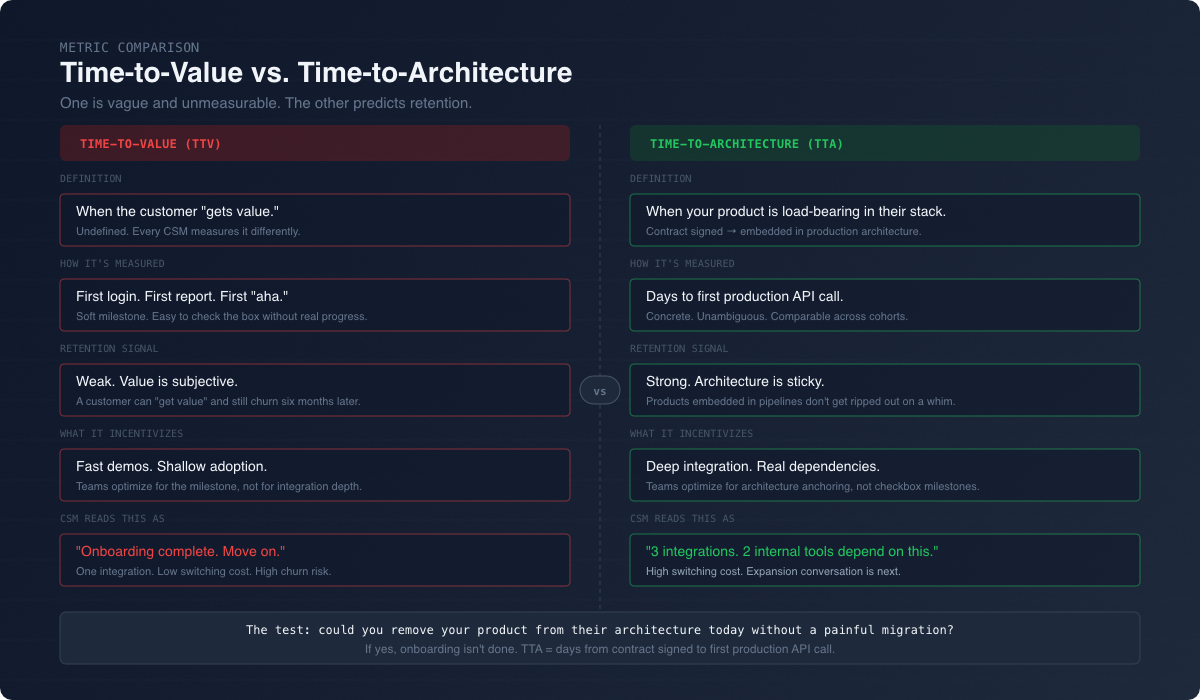
Stop measuring time-to-value. It’s vague, difficult to define, and almost impossible to benchmark consistently. Replace it with time-to-architecture: the elapsed time between contract signing and the customer having your product embedded in their production architecture in a way that would be painful to remove.
TTA is a real number. It’s measurable. And it predicts retention far better than any satisfaction survey.
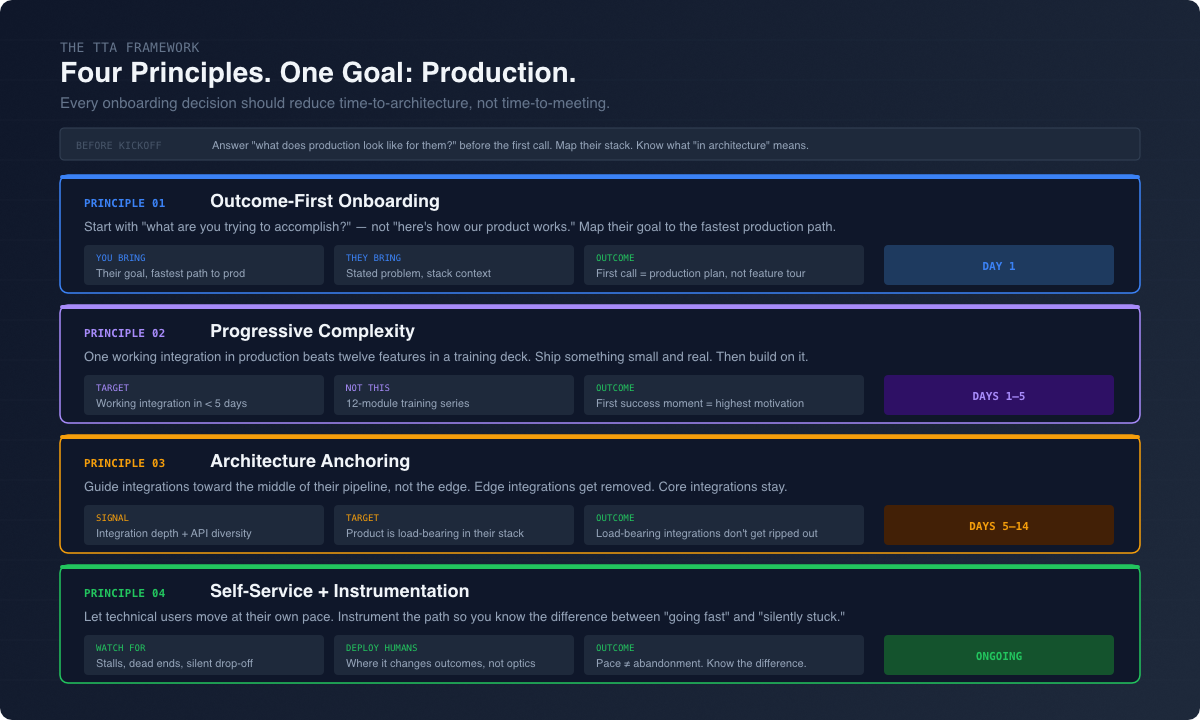
Four principles:
1. Outcome-first onboarding: Start with "What are you trying to accomplish?" not “here’s how our product works.” Most CSMs start onboarding by walking through feature menus. Technical buyers tune out immediately. Map their stated goal to the fastest implementation path before you touch a single slide.
2. Progressive complexity: Get them to a working integration in hours, not weeks. One integration that works in production is worth more than a 12-module training course that ends with “now let’s schedule the kickoff.” Think about how the best developer tools work: Stripe's accepting a payment in 5 minutes, Twilio’s first SMS, and Vercel’s first deploy. The entire UX is designed around the moment of first success. Your onboarding should be no different.
3. Architecture anchors: Deliberately help customers integrate in ways that create healthy dependencies. Not lock-in for its own sake, but genuine architectural value that makes your product load-bearing. An integration that sits on the edge of someone’s stack is easy to remove. One that sits in the middle of their data pipeline is not. Guide them toward the middle.
4. Self-service with instrumentation: Let technical users move at their own pace. Forcing them into a CSM-led process every step of the way is friction, not service. Build docs, quick starts, and templates that make self-direction the path of least resistance, but instrument the journey so you know when someone is stuck, stalled, or going down an implementation dead end.
Why CSMs Keep Getting Onboarding Wrong
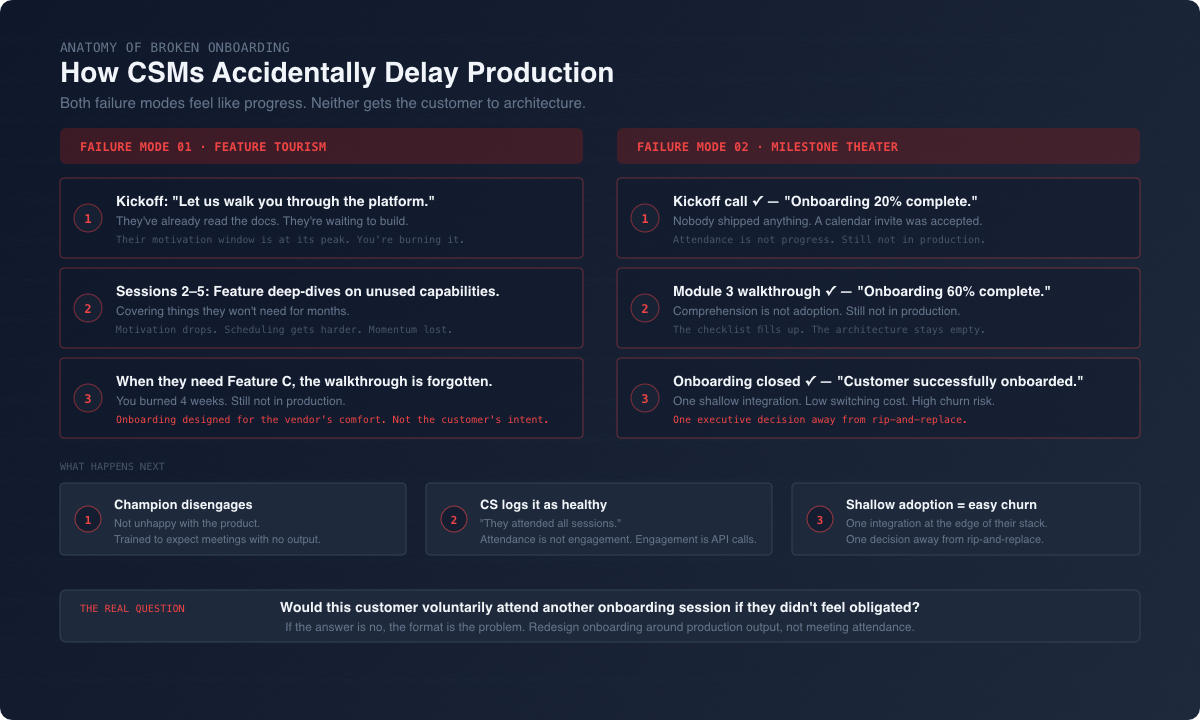
There are two failure modes I see frequently.
The first is feature tourism. The CSM walks the customer through every part of the product in the first few sessions, covering things the customer won’t need for six months. By the time they actually need something, they’ve forgotten the walkthrough. Meanwhile, you've missed the opportunity when they're most eager to act quickly.
The second is milestone theater. The onboarding plan has 14 steps, each marked complete when the customer sits through a meeting. But meeting attendance isn’t progress. The only milestone that matters is whether this thing is in production. Everything else is a process.
The underlying problem in both cases is that the onboarding is designed around the vendor’s comfort, not the customer’s intent. CSMs want a structured sequence they can report on. Engineers want to ship something.
What TTA Changes
When you organize onboarding around time-to-architecture, a few things shift.
First, kickoff calls change. Instead of “let’s review the onboarding timeline,” the first call is, "What does your production architecture look like today, and where does our product fit?” That’s a conversation technical buyers actually want to have.
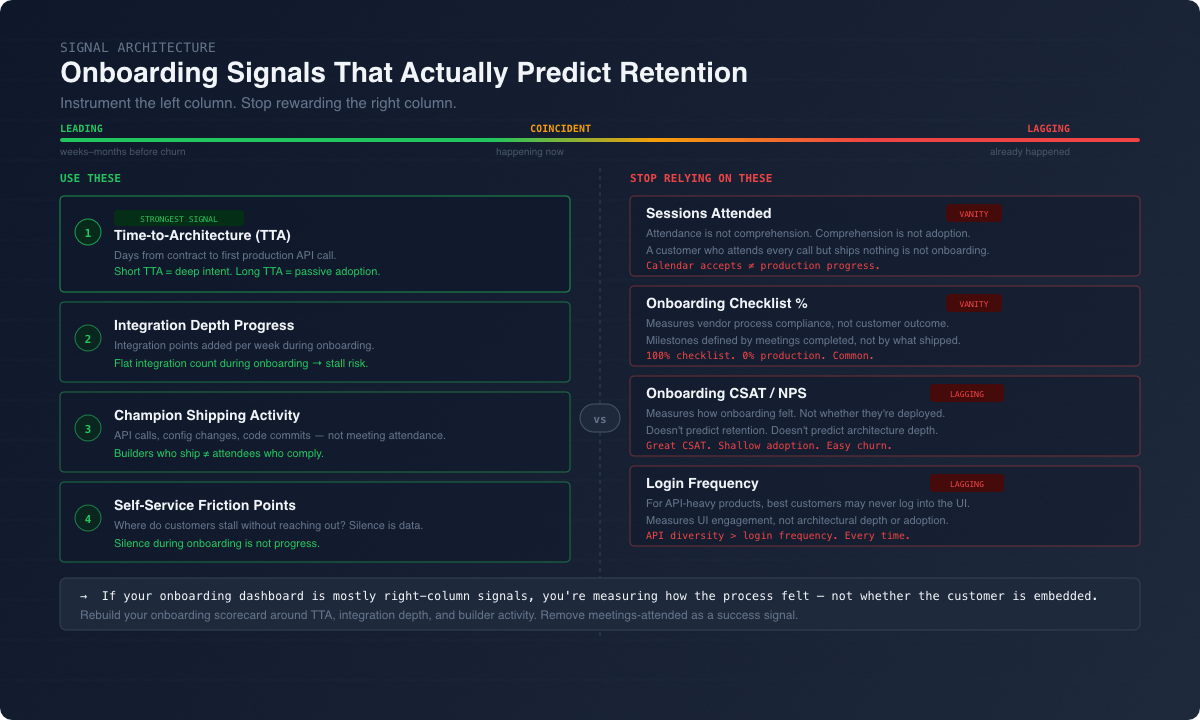
Second, success milestones become real signals. “Completed module 3” tells you nothing. “First API call in production” tells you a lot. “Product embedded in two workflows” tells you you’re probably going to retain this account.
Thirdly, CSM time is allocated to the edges. A significant portion of onboarding effort is often directed towards customers who are likely to understand it on their own. TTA instrumentation shows you who’s actually stuck so you can deploy human attention where it changes the outcome, not where it provides the appearance of service.
The Prompt Library
Prompt 1: Onboarding Path Generator
A new customer just signed. Based on their profile, design a personalized onboarding path optimized for minimum time-to-architecture.

Customer profile:
- Company size: {size}
- Technical maturity: {low/medium/high}
- Primary use case: {use case}
- Existing tech stack: {tools and platforms}
- Decision maker role: {title}
- Implementation team: {who's doing the work}
- Success criteria stated during sales: {criteria}

Generate:
1. The single fastest path to a working production integration (target: under 2 weeks)
2. Three milestone checkpoints with specific observable signals that confirm progress
3. Potential friction points based on their stack and maturity level
4. Recommended self-service resources to send before the kickoff call
5. Questions to ask in the kickoff that a traditional onboarding script would miss
Prompt 2: Onboarding Friction Detector
Review the following onboarding data for customers who started in the last 90 days. Identify where TTA is breaking down.

Onboarding data:
{structured data: customer, start date, current milestone, days at each stage, support tickets opened, CSM touchpoints}

Analyze:
1. Which stage has the longest average dwell time?
2. Are there segments (by company size, use case, or stack) that consistently stall?
3. What support ticket patterns emerge during onboarding?
4. Which customers reached production integration fastest — what did they have in common?

Recommend 3 specific changes to the onboarding process that would reduce average time-to-architecture.
One Metric to Add This Week
If you’re not tracking TTA today, start with a proxy: days from contract signed to first production API call (or equivalent for your product). Pull the last 90 days of new customers. Segment by company size and technical maturity. Find the outliers (the customers who got there fast) and figure out what they had in common.
That pattern is your new onboarding template.
This is the third post in a series on rebuilding Customer Success for technical products. If you missed the first one, start here: Your Health Score Is a Horoscope. Subscribe at michaelpgoetz.substack.com if you’re building CS for people who build software.