

Every CS org I’ve worked in celebrates the same person: the CSM who drags an at-risk account back from the edge in the final two weeks before its renewal. The story gets retold at the all-hands. There’s usually a gift card.
I’ve stopped clapping for those saves. A rescue in the last stretch isn’t really a win. It’s the receipt for a risk the system should have caught a quarter earlier, when there was still time to handle it quietly and without drama.
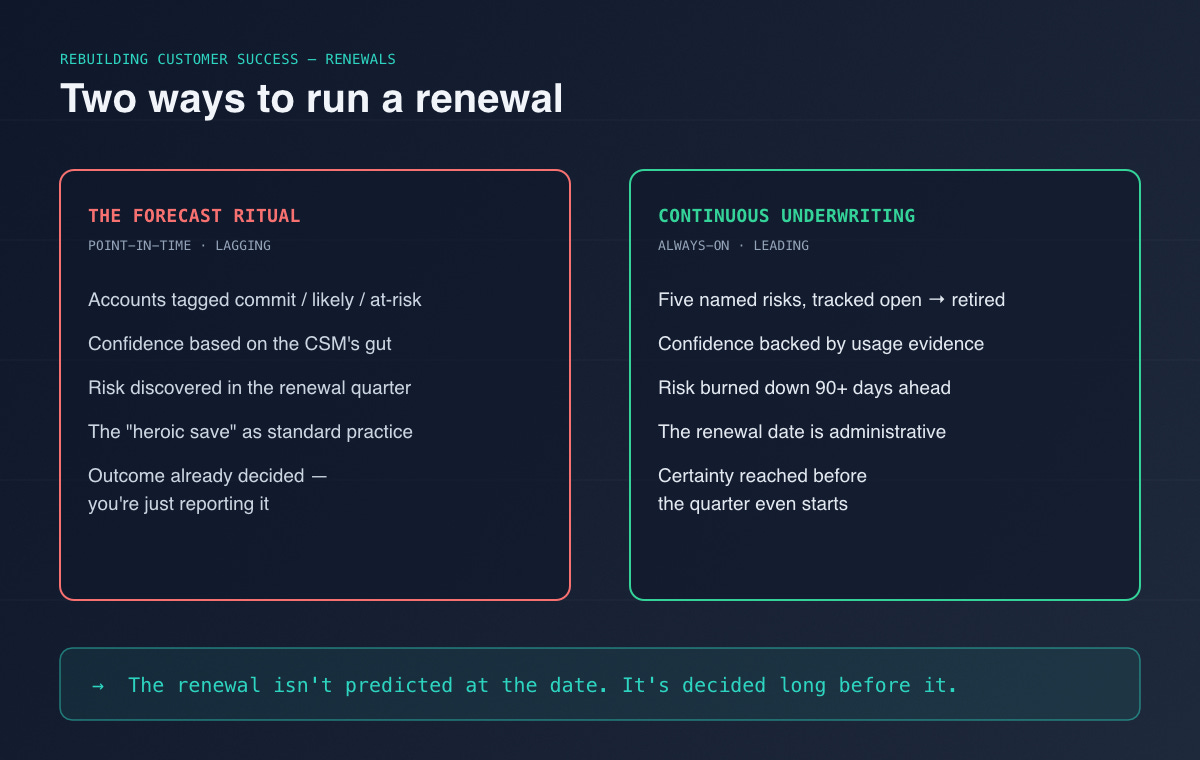
That’s the uncomfortable part of renewal forecasting. By the time an account lands on a forecast call tagged “commit,” “likely,” or “at-risk,” most of the outcome is already set. The work that determines whether a renewal occurs takes place in the months before anyone opens the spreadsheet. So the forecast doesn’t really predict the renewal. It reports on it a little early and calls that a prediction.
I wrote a while back about why health scores mislead, how they lean on lagging signals that describe what already happened rather than what’s coming. Renewal forecasts have the same flaw, just further down the timeline. They’re the last and most expensive lagging indicator you’ll stare at before the number either lands or it doesn’t.
A quick note on who “you” are here. I’ll keep saying CSM, but read it as “whoever owns the account.” The CSM and AM titles are merging into a single role that manages both the relationship and the number, and once this happens, renewal risk will rest squarely on that person’s desk.
The framework: Continuous Renewal Underwriting (CRU)
The solution isn’t a better forecast. It’s a different job. Stop forecasting renewals and start underwriting them.
An insurer doesn’t gather in a room at year-end to guess whether a policy will pay out. They price the risk continuously and work to bring it down where they can. A renewal is that kind of object. It’s a position you manage every week, not a coin you flip at the buzzer.
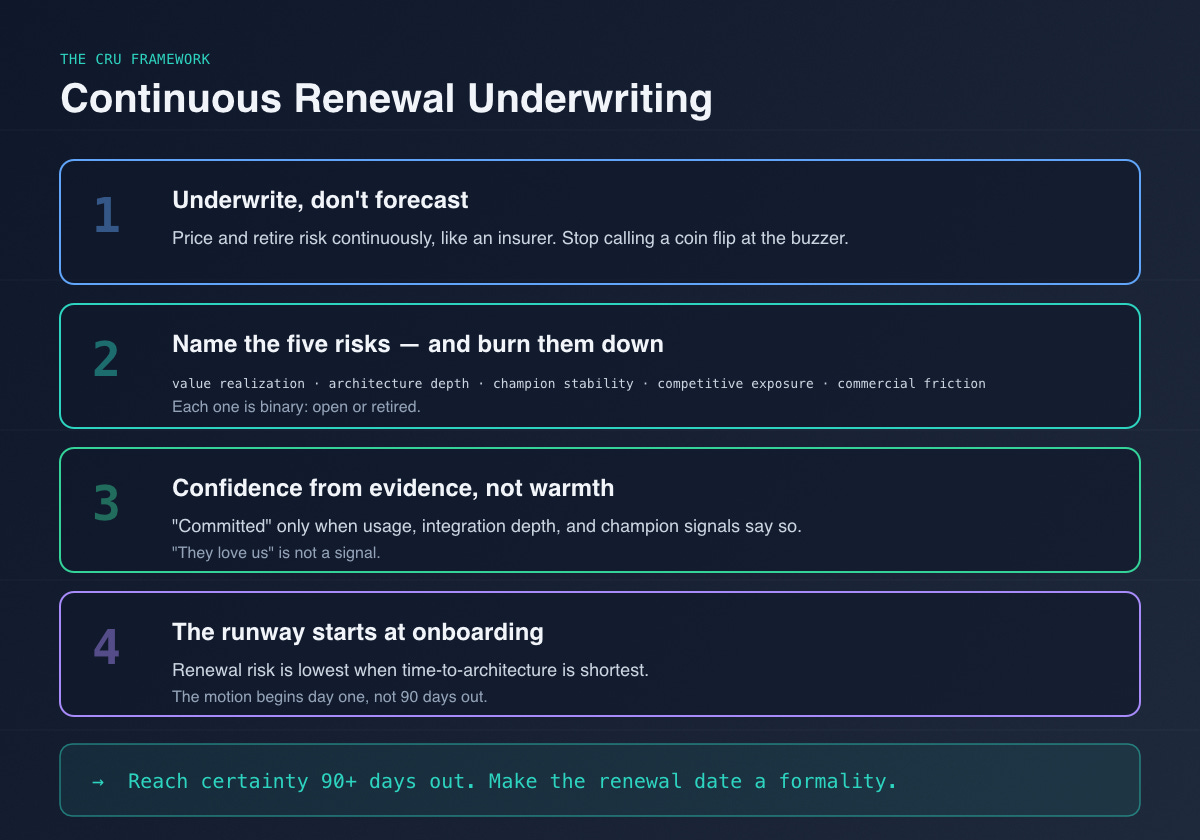
CRU has four parts.
1. Underwrite, don’t forecast. A forecast guesses at an outcome you’ve quietly decided to treat as fixed. Underwriting assumes you can still move it. The shift is from reporting a renewal to working one. Every account holds a live risk position, and the goal is to drive that position toward certainty before the date arrives.
2. Name the five risks, then retire them. “At-risk” is a useless label because it never says why. In practice every renewal carries a small, nameable set of risks: whether the customer has realized the value they bought, how deeply your product is wired into their stack, whether your champion is still in seat and still influential, whether a competitor or an in-house build has entered the picture, and whether something commercial is going to get in the way (budget timing, procurement, a pricing change, an old support scar). Each of those is either open or handled. The operating model is a steady campaign to close them out ahead of the date.
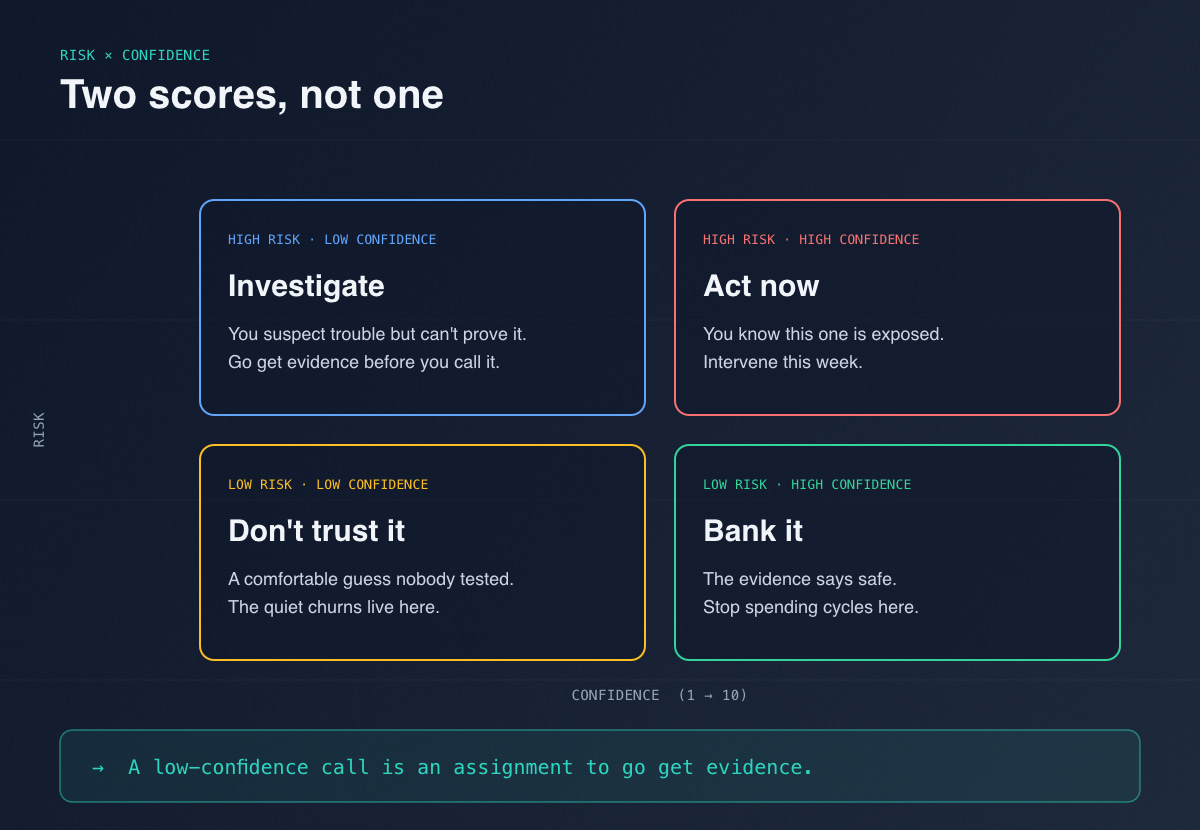
3. Score the risk and your confidence separately. Give every account two numbers instead of one. First, a risk level: high, medium, or low. Second, a confidence score from 1 to 10 for how sure you are of that read. Keeping them apart is the whole point. “Medium risk, and I’m highly confident” and “I think this is high risk, but honestly I’m not sure” are very different situations, and a single commit-or-at-risk tag flattens them into the same box. The low-confidence accounts are where the work is. A shaky read is your cue to go pull the evidence (adoption, integration depth, the cadence of champion engagement) until a number you can stand behind shows up. And “they love us” still doesn’t count as evidence: warm accounts churn quietly every quarter when the relationship was real but the product was never load-bearing.
4. The runway starts at onboarding. Renewal risk is lowest when a customer reaches a working, embedded deployment fast. That’s the time-to-architecture idea from an earlier post, viewed from the far end. Every dependency you help a customer build early is risk you won’t have to fight later. By renewal time, a well-onboarded account re-signs about as deliberately as it pays the electricity bill.
Plot those two scores against each other and you get a simple picture of where to spend the week.
The first 120 days do most of the deciding
Most of a renewal is settled in the first 120 days. That window is where a customer forms their real opinion of whether this was a good decision, and that opinion tends to stick.
Year one is more forgiving than people expect. Enterprise software is messy, and almost nobody gets a clean first year: there are product gaps, a rough integration, a support miss or two. None of that is fatal on its own. If you’ve been visibly in the trenches with the customer, working the problems and showing progress, you can usually earn the first renewal even after a bumpy year. Effort buys you grace.
Year two is where the bill comes due. The grace is spent, and the thing that carries the renewal now is whether the customer actually reached value. If they’re still a long way from it heading into year two, the renewal is most likely already lost, whatever the forecast claims in the quarter it falls due. At that point you’re just waiting for the date to confirm what the first 120 days already decided.
One number worth watching: Time-to-Certainty
Forecast accuracy is the wrong headline metric. A more honest one is time-to-certainty: how far ahead of the contract date your confidence on an account climbs into the high end of that 1-to-10 scale and stays there.
Good teams reach that point a full quarter out. If you’re still uncovering real risk inside the renewal quarter itself, your time-to-certainty is effectively negative, and the confidence in the room is theater no matter how loud it gets.
Two ways the forecast lies
The hope forecast. Confidence built on rapport instead of evidence. The QBRs are friendly and the champion takes the call, so the account goes down as commit. Then it lapses and everyone claims to be surprised. Rapport feeds retention, but it doesn’t prove it. A call you can’t tie to a signal is a wish wearing a label.
The eleventh-hour scramble. Risk that only surfaces inside the renewal quarter, once there’s no runway left to do anything but react. This is what breeds the heroic-save culture in the first place. A champion’s departure flagged at 150 days out is a manageable problem. The same departure flagged at 20 days out is a fire drill.
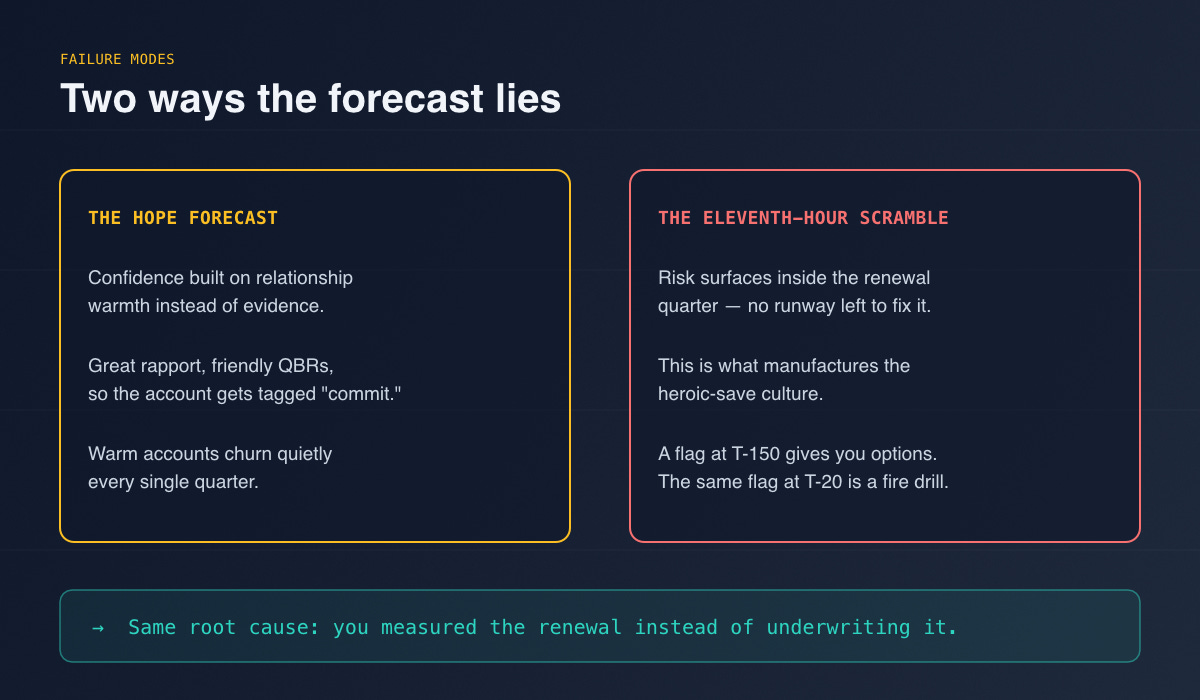
Both come from the same habit: measuring the renewal instead of underwriting it.
The prompts
Three tools to put CRU to work. One sizes up a single account, one audits the whole forecast, and one runs the portfolio on a schedule.
Prompt 1: Renewal Risk Underwriter
You are a Customer Success renewal underwriter. Given the account data below,
produce a renewal risk position — not a gut forecast.

Account data:
- Account name / segment: {name, segment}
- Contract value (ARR): {value}
- Renewal date: {date} (today is {today})
- Value realization: {has the customer hit their stated success criteria? evidence?}
- Architecture depth: {integrations, API usage diversity, workflow dependencies}
- Champion: {role, tenure in seat, recent engagement, any role changes}
- Competitive/build signals: {any competitor or in-house alternative mentioned}
- Commercial context: {budget cycle, procurement notes, pricing changes, past friction}
- Usage trend (90 days): {increasing / flat / declining}

Produce:
1. A risk rating (Open / Retired) for each of the five factors: value realization,
   architecture depth, champion stability, competitive exposure, commercial friction.
2. Two separate scores: a risk level (High / Medium / Low) and a confidence score
   (1-10) for how sure you are of that read. State the specific signal behind each.
   Don't award high confidence to an account whose evidence is thin.
3. Time-to-Certainty: based on the data, how many days before the date can we
   credibly reach certainty? Are we on track?
4. A prioritized runway plan: the top 3 actions to retire the highest open risks first,
   sequenced against the renewal date.
Prompt 2: Forecast Auditor
I'm going to share our current renewal forecast. Stress-test it for the two failure
modes below, the way a skeptical CRO or board member would.

Failure modes to flag:
- The hope forecast: a "commit" or "likely" rating justified by relationship warmth
  rather than usage, adoption, integration, or champion evidence.
- The eleventh-hour scramble: any account whose risk was discovered inside the renewal
  quarter, where there is no longer enough runway to retire it.

Current forecast:
{paste forecast — account, ARR, current rating, renewal date, and the stated reason
for the rating}

For each account:
1. Is the rating evidence-backed or hope-based? Name the missing evidence if hope-based.
2. How much runway remains (days to date), and is it enough to retire any open risk?
3. Assign a risk level (High / Medium / Low) and a confidence score (1-10), and flag
   any high-confidence rating the evidence doesn't support.

Then summarize: total ARR sitting on hope, total ARR you're low-confidence on, total ARR
with no runway left, and the three accounts most likely to become a "surprise" churn.
Agent workflow: Renewal Runway Monitor
You are an AI agent monitoring a portfolio of upcoming renewals. Run weekly. For every
account with a renewal date in the next 180 days, track risk retirement against the clock.

Portfolio data:
{structured account data: name, ARR, renewal date, the five risk factors with current
status, usage trend, last champion contact, support themes}

Checkpoints: 180 / 120 / 90 / 60 days out.

For each account, evaluate:
1. Risk-retirement velocity: are open risks closing fast enough, and is confidence on the
   account climbing toward a level you'd stake the forecast on, by 90 days out? Compare
   this week's status to last week's.
2. Flag any account where an open risk is not being retired at a pace that fits its
   remaining runway. Mark urgency: routine / elevated / critical.
3. For critical flags, recommend the single highest-leverage action to retire the
   blocking risk this week, and whether the CSM should act directly or equip the champion.

Output a one-page briefing: accounts on track, accounts slipping, and the week's must-do
runway actions ranked by ARR-at-risk.
Your turn
Two questions I’m genuinely curious about. What’s the earliest signal that has reliably predicted a churn for you? And what’s the warmest account you’ve ever lost? The renewals nobody saw coming usually hold the best lessons.
And if you’ve built a renewal-risk prompt or workflow that’s working well, send it over. I keep a running collection of what’s actually working from people doing this in technical accounts, and the good ones get shared.
New here? The earlier posts on health scores and on onboarding technical buyers set up a lot of what’s above.